
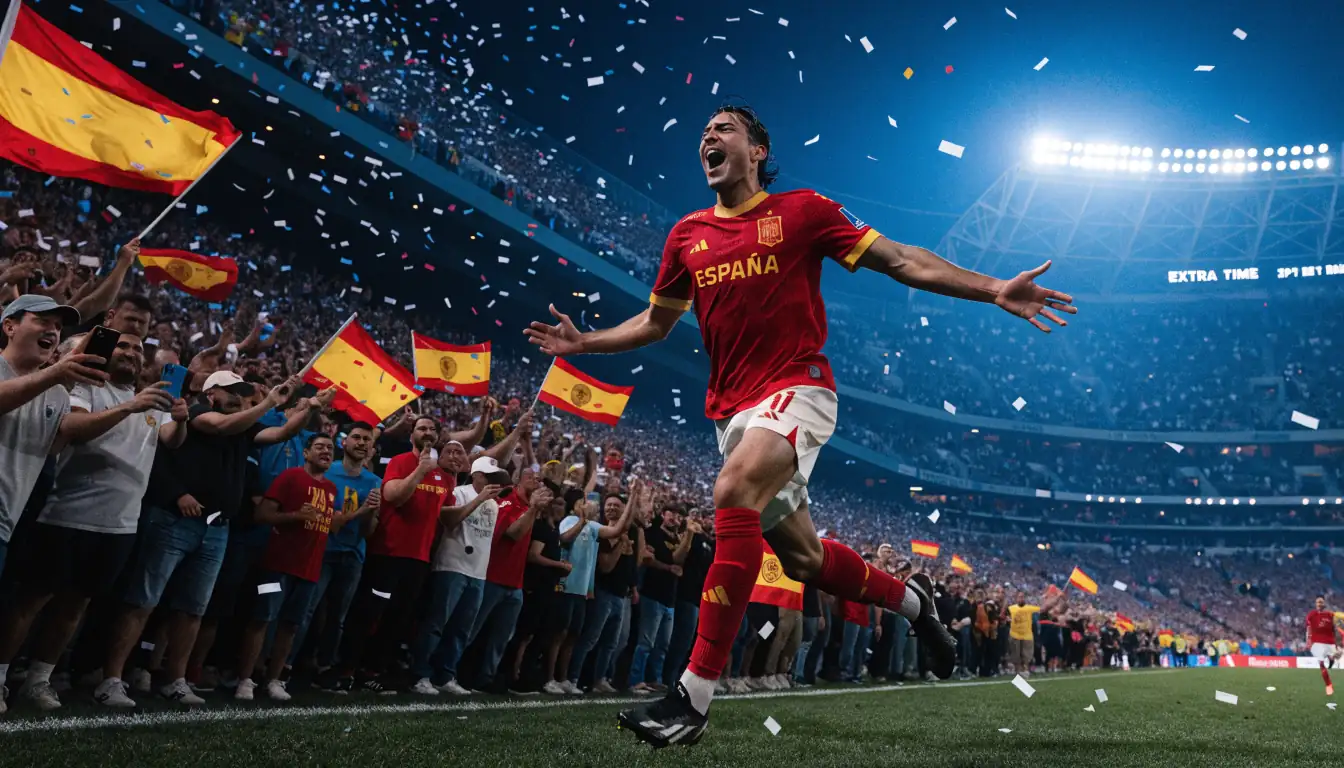
In the 106th minute of the World Cup final, Pedro Porro crossed from the right, Nico Williams headed the ball back into the middle of the penalty area, and Ferran Torres struck it first time beneath the crossbar. Emiliano Martínez, who had repeatedly kept Argentina alive, could do nothing. The goal was Torres’s first of the tournament and Spain’s only goal in the final, but it was enough to restore the country’s title after a 16-year wait. Luis de la Fuente’s team defeated Argentina 1–0 in extra time and became world champions for the second time. FIFA’s final report
A day earlier, England and France scored ten goals in the bronze-medal match. England won 6–4, while France’s Kylian Mbappé finished the tournament with ten goals and set a new scoring record for World Cups. At the other end of the standings were teams for whom scoring even once was a historic achievement. The first World Cup with 48 teams contained both Mbappé’s record and the debut of Cabo Verde, which did not lose a match in normal time. FIFA final standings, tournament statistics
How Spain won the World Cup
Spain opened the tournament with a goalless draw against Cabo Verde. For the reigning European champions, it was an unexpected result; for the debutants, it was their first point at a World Cup. The problem Spain faced in that match returned in the final. When an opponent defended deeply, possession alone was not enough. Spain had to move defenders out of position, find the free player and exploit the brief opening created while the defense reorganized. In the opening match, the Spaniards never found an effective finish. FIFA final standings
After that draw, de la Fuente’s team won seven matches in a row. In the group stage, Spain defeated Saudi Arabia and Uruguay. In the round of 32, it beat Austria 3–0, with Mikel Oyarzabal scoring twice and right-back Pedro Porro adding the other goal. The next rounds were tighter. Spain defeated Portugal 1–0 and then beat Belgium 2–1 in the quarterfinals. Across three consecutive knockout rounds, the champions had to solve different problems, but none required a penalty shootout. Knockout-stage results, report on the Austria match
The semifinal against France showed how important Spain’s players arriving from deeper positions were to the team. Oyarzabal opened the scoring from the penalty spot in the 22nd minute, and Porro scored the second after halftime. France, the 2022 World Cup finalist, lost 2–0 and failed to score for the first time in the tournament. Spain denied its opponent the chance to level and force the match into the kind of contest where one successful Mbappé burst could overturn everything that had come before. Porro was again central to the decisive attack in the final, although the goal officially belonged to Torres after Williams’s assist. France’s results, final report
Spain won the tournament while conceding only one goal. That record was especially notable given the opponents it faced in the later rounds. Portugal, France and Argentina all had players capable of deciding an incident on their own, yet none of those teams scored against Spain. The way Spain used the ball also helped preserve its defensive reliability. Opponents had to spend energy defending and then find a way to move forward after winning possession. In the final, Argentina managed only two shots in 120 minutes, while Spain attempted 20. FIFA final standings
Why the final lasted 120 minutes
Both teams reached the final unbeaten. Spain arrived in New Jersey as European champion, while Argentina was the champion of South America and the reigning world champion. Argentina had scored 19 goals in its previous rounds, but in the final it did not take its first shot until extra time. Lionel Messi, whose passes and goals had repeatedly rescued his team on the way to the final, spent long periods without the ball in positions from which he could threaten. Spain forced him to look for possession farther from goal and then closed off his passing options. FIFA’s final report
The first serious chance came in the fifth minute. Dani Olmo found Lamine Yamal on the right side of the penalty area, but Martínez blocked the near post. Later, the goalkeeper stopped a shot from Oyarzabal and, in the second half, saved Torres’s header after a Yamal cross. Near the end of normal time, Yamal struck a dangerous free kick, and Martínez rescued Argentina again. The goalkeeper made 12 saves in total. According to the Associated Press, that was a record for a World Cup final. Each additional save brought Argentina closer to a penalty shootout and kept alive its chances in a match largely controlled by Spain. FIFA’s final report, Associated Press report
During the match, Lionel Scaloni had to replace both of his central defenders. Lisandro Martínez went off before halftime, and Cristian Romero was substituted in the second half. In stoppage time, Enzo Fernández received a second yellow card for a foul on Pau Cubarsí. Argentina therefore entered extra time with a reshaped defense and one fewer player. Spain continued attacking through the wings, and its fresh players found more opportunities to enter the penalty area. One Spanish goal was disallowed before Torres’s strike, and another was ruled out afterward. FIFA’s final report
The winning move took only a few seconds. Porro sent the ball toward the far post, Williams returned it to a better position for a shot, and Torres needed only one touch. The forward had started Spain’s opening match against Cabo Verde, then lost his place in the starting lineup, and began the final on the bench. His tournament could easily have ended without a goal. Instead, he matched the achievement of Andrés Iniesta, whose extra-time strike in the 2010 final gave Spain its first world title. Both decisive matches ended 1–0. FIFA on Ferran Torres’s performance
How Argentina reached the title defense
Argentina won all three group matches, but it soon had to fight for survival in the knockout stage. Cabo Verde scored twice against the defending champions and took the match into extra time. Argentina won 3–2. In the next round, it defeated Egypt by the same score, and then faced Switzerland in the quarterfinals. The teams were level after 90 minutes, and Argentina finally moved ahead to win 3–1 in extra time. The two-goal margin in the final score concealed how long the outcome remained uncertain. Cabo Verde match report, knockout-stage results
The team’s character was most evident in the semifinal against England. Early in the second half, Anthony Gordon put England ahead. Argentina struggled to equalize, but late in the match Messi created two chances that teammates converted. Enzo Fernández scored first, followed by Lautaro Martínez. The 2–1 victory sent Argentina to its seventh World Cup final. Messi appeared in a final for the third time, after 2014 and 2022. Before him, only Brazil’s Cafu had played in three finals. Semifinal report, final statistics
Messi’s eight goals earned him the Silver Boot and the Silver Ball as the tournament’s second-best player. His passes decided the semifinal, while his finishing mattered in other matches. The final demonstrated how much Argentina depended on regularly getting the ball to him. Spain blocked that route and forced Argentina to spend much of the match near its own goal. Scaloni’s team retained a chance of defending its title until the end, but it could not turn the final around as it had against England. FIFA individual awards, final report
England’s bronze and France’s record
Thomas Tuchel’s England finished top of its group and then defeated the Democratic Republic of the Congo, Mexico and Norway. In Mexico City, England beat the hosts 3–2. In the quarterfinal, it needed extra time to overcome Norway 2–1. England took the lead in the semifinal but lost to Argentina. The third-place match offered a chance to end the tournament with a medal. The last time England had reached that height was in 1966, when it won the title at home. FIFA final standings, knockout-stage results
By halftime of the match in Miami, England led 4–0. The game might have ended comfortably at that score, but France returned in the second half and scored four goals. England responded with two more to win 6–4. Bukayo Saka scored three times and was named player of the match. The contrast with the final was almost absolute. In Miami, a four-goal lead did not spare England a nervous ending; the following day in New Jersey, a single accurate shot determined the champion. FIFA report on the bronze-medal match
France defeated Sweden, Paraguay and Morocco before losing to Spain. After winning the 2018 title and taking silver in 2022, Didier Deschamps’s team finished fourth in 2026. Mbappé’s performance was France’s main individual achievement. He scored ten goals and won the Golden Boot for the second consecutive tournament. His two goals against Senegal in the opening round moved him to the top of France’s all-time scoring list, and by the end of the tournament he had also become the leading scorer in World Cup finals history. He now had 22 goals. France’s tournament path, FIFA on Mbappé’s record
The other major individual awards went to champions. Rodri received the Golden Ball, Unai Simón won the Golden Glove, and Pau Cubarsí was named the best young player. Simón also set a separate record: his World Cup clean-sheet run reached 650 minutes, surpassing the previous mark held by Italy’s Walter Zenga. Spain’s three awards represented different positions in midfield and defense. The forward who scored the tournament-winning goal received the award for best player in the final. 2026 World Cup awards, FIFA statistics
What 48 teams changed
The tournament was held from June 11 to July 19 in the United States, Canada and Mexico. A total of 104 matches were played in 16 cities. FIFA reported total attendance of more than 6.8 million. The previous World Cup in Qatar had featured 32 teams and 64 matches. Under the new format, the 48 teams were divided into 12 groups. The top two teams in each group and the eight best third-place teams advanced to the knockout stage. A round of 32 was added, meaning that a team now had to play eight matches rather than seven to win the title. FIFA schedule and results, attendance report
The group stage carried different incentives. Finishing third still offered a chance to continue, so goal difference mattered for some teams even after catching the top two had become impossible. At the same time, finishing first provided only the right to play one additional knockout match. Argentina won its group without dropping points but then played 120 minutes against Cabo Verde in the round of 32. For teams with deeper benches, the extra round increased the value of substitutions. For debutants, it created another opportunity to test themselves against a strong opponent. Knockout bracket, Argentina–Cabo Verde match
The 104 matches produced 308 goals. The overall record was partly a consequence of the increased number of games, but average scoring also rose. The tournament averaged 2.96 goals per match, the highest rate since 1970. England and France contributed ten goals in their match, while Canada scored six against Qatar. The debutants also made an impact. All four newcomers—Cabo Verde, Curaçao, Jordan and Uzbekistan—scored at least once. Jordan scored in all three group matches. FIFA tournament statistics
The expansion was even more visible in the knockout field. Nine African teams reached the round of 32. Previously, no World Cup knockout stage had included more than two African teams. Egypt advanced from the group stage for the first time, defeated Australia on penalties and then lost to Argentina by one goal. Morocco reached the quarterfinals. A direct comparison between nine African teams in the knockout stage and two in the past is difficult because the new round itself doubled the size of the field. Even so, African teams clearly received more matches in which one successful performance could carry them further. FIFA confederation statistics, knockout-stage results
Cabo Verde, Canada and Norway
Cabo Verde’s story went far beyond its opening 0–0 draw with the eventual champion. The debutants drew all three group matches, including a 2–2 result against Uruguay, and reached the knockout stage. There, they held Argentina for 90 minutes and lost only in extra time. Across four matches, Cabo Verde faced three former world champions and did not lose to any of them in normal time. It did not win a match either. The team demonstrated how far a side can go when it keeps its chances alive even in matches where the opponent usually controls possession and initiative. FIFA statistics on debutants, report on the Argentina match
Canada, playing at a home tournament, earned its first World Cup point and then recorded its first victory by beating Qatar 6–0. Jonathan David scored a hat-trick in that match. Canada then defeated South Africa in the first knockout round but lost 3–0 to Morocco in the round of 16. Before 2026, Canada had not earned a point in the World Cup finals, so reaching the last 16 was a significant achievement. Mexico and the United States also ended their campaigns at that stage, losing to England and Belgium respectively. All three hosts advanced from the first knockout round, but none remained for the quarterfinals. FIFA statistics on first achievements, knockout bracket
Norway produced one of the knockout stage’s biggest surprises by defeating Brazil 2–1. Erling Haaland scored both Norwegian goals, taking his tournament total to seven at that point. Brazil responded with a late Neymar penalty but could not equalize. In the quarterfinal, Norway took England into extra time before losing 2–1. The match against Brazil was memorable for another reason: Neymar became the second Brazilian after Pelé to score at four different World Cups. An evening that ranked among the best in Norway’s football history was also Neymar’s final match for the national team. FIFA’s New Jersey match review, quarterfinal results
How the 2026 World Cup will be remembered
The first World Cup with 48 teams produced several different measures of success. For England, bronze was its best result in 60 years. For Canada, the milestone was its first victory, followed by a place in the round of 16. Cabo Verde challenged expectations for a team appearing at the tournament for the first time. Mbappé set a record built across three World Cups. Messi played in his third final and again showed in the knockout stage how two passes could change the fate of an entire match within minutes. FIFA final standings, tournament awards
Spain’s title was built on its ability to change a match through different players. Oyarzabal scored early in the knockout stage, Porro found the net in the semifinal, and Williams and Torres came off the bench to influence the decisive final. Argentina held Spain scoreless for 105 minutes despite losing defenders and being reduced to ten men. One minute later, Porro’s cross traveled across the penalty area, Williams returned it toward the center, and Torres had exactly enough time for one shot. Across 104 matches, the tournament produced 308 goals. The last one decided who would take home the trophy. Final report, FIFA tournament statistics
